I’ve always loved Debussy’s Children’s Corner and especially the opening piece, Doctor Gradus ad Parnassum. This delightful set of six pieces isn’t necessarily intended for children to play, but instead reflects the imaginative and fanciful world a child’s mind might inhabit.
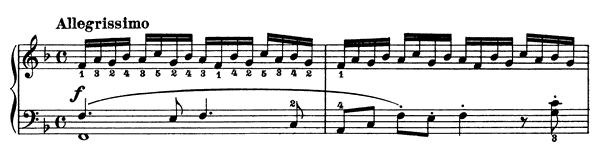
Doctor Gradus ad Parnassum was written as a sort of satire towards Muzio Clementi’s 1807 famous keyboard studies Gradus ad Parnassum (Steps to Perfection). The piece is written to mimic the strenuous and monotonous style of Clementi’s Gradus, but soon becomes more much more playful and whimsical. The opening 2 bars of Clementi’s 1807 Gradus are shown below:
Here’s Debussy’s 1908 version:
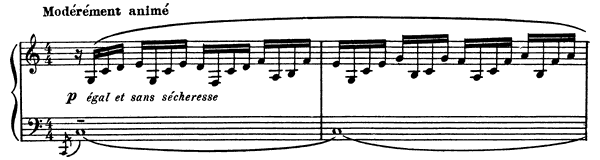
Both have long runs of 16th notes in the right hand, and are both technically challenging, but the chords Debussy uses quickly evolve away from the tonic and take on more character and color.
Debussy’s Gradus is full of similar examples that poke fun of the challenges of piano practice, especially for children and beginners. One of my favorite examples is the slower section in the middle (m. 33) where the music begins to almost get lost in a day-dream.
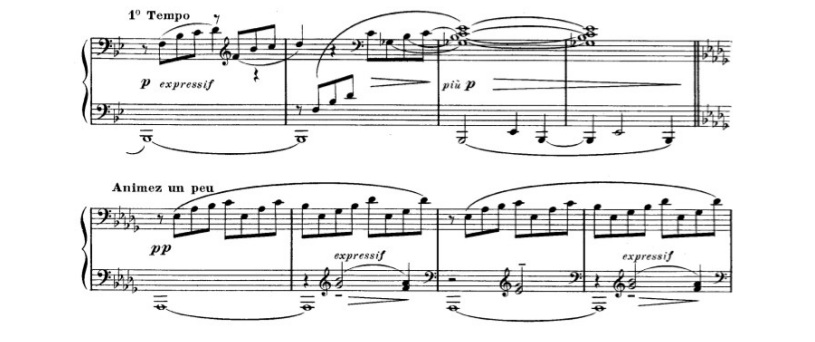 It’s easy to imagine Debussy trying to capture the thought process of a distracted child at the keyboard: somewhat bored and lost in thought, thinking of and inventing new versions of the music they’re supposed to be practicing. I additionally love how that reverie is broken when the main theme returns, but over a dominant octave of Gs in the lower register. It makes for a somewhat abrupt but beautiful awakening:

Here’s a recording I did the other day of the piece in its entirety. Send me any questions or comments! I’d love to talk more about this wonderful piece! Enjoy!
 Glenwood Piano Studio